
Are you looking for interesting books about Boston?
One of the best parts about planning any trip is poring through travel books ahead of time.
If you love to learn as much as possible about where you're going, local history, and the people who live there, these books will give you new insights about Boston.
The following list of 12 books is by no means comprehensive, but will get you off to a good start.
We include Amazon links (#ad), and as you'll see, you can often buy used copies for just pennies. Please note that as an Amazon Associate, Boston Discovery Guide earns from qualifying purchases.
In addition, be sure to also check our recommendations for Boston travel guidebooks as well as cookbooks by Boston chefs.
Top photo: Outdoor seating at Boston's City Hall Plaza, (c) Boston Discovery Guide
Boston Discovery Guide is a reader-supported publication. When you buy through our links, we may earn a commission at no additional cost for you. Learn more
Please note: Some links on this page go to Amazon.com. As an Amazon Associate, BostonDiscoveryGuide.com earns from qualifying purchases.
1. Boston's Downtown Movie Palaces
By Arthur Singer and Ron Goodman, 2011
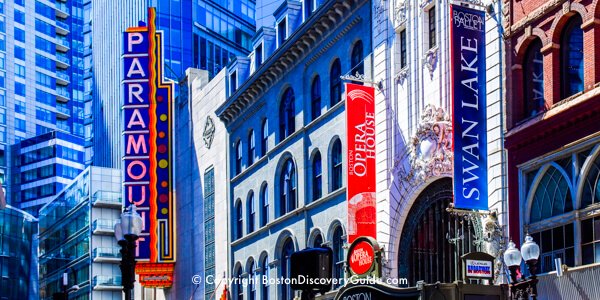
Boston has the largest number of preserved and restored historic theaters in the United States, and many of them began their lives 100+ years ago as magnificent movie "palaces."
Boston's Downtown Movie Palaces, part of a series about movie palaces in cities across America, provides fascinating details about the art, architecture, and histories of these entertainment venues.
Thanks to Boston's restoration efforts, more of these theaters than you might expect - Wang Theatre, Colonial Theatre,Modern Theatre, just to name a few - still exist and flourish in Boston today.
As a bonus, the historic photos are outstanding - especially if you compare them with the theaters as they now appear (see our Boston Theaters article for current photos, or take the Wang Theatre tour to get a first-hand view.
2. Boston's Best Dive Bars: Drinking and Diving in Beantown
By Luke O'Neil, 2011
Until just a decade or two ago, Boston's then-gritty landscape provided the perfect background for the city's favorite gathering spot: dive bars.
Now, these favorite no-frills watering holes, full of history, comraderie, and good times, are an endangered species.
If you want to understand the "real" Boston of yesteryear, Boston's Best Dive Bars will show you where you can still get a glimpse of 90 of the city's best remaining taverns before they all disappear, victim to high real estate prices and more upscale expectations.
Boston Insider's Tip: Before visiting any drinking establishment recommended by this book, google it first . . . just to confirm that it still exists.
3. Boston Sites and Insights
By Susan Wilson and Susan Carolyn Wilson, 2004
So much of what we know about events in Boston during previous centuries comes from eye-witness accounts, as recorded in journals, letters, newspapers, and even old photographs.
Of course, people see things in individual ways - and even eye-witness accounts often contradict each other. How do you know if what you learn from history books is "true" or "accurate" vs "fake news"?
A strength of Boston Sites and Insights, which describes Boston's major historical sites and attractions, is that the authors (a mother-daughter team) cite original sources as much as possible. Where eyewitness reports or records differ from each other, they say so.
As a result, what you'll find here sometimes differs a lot from the "popular wisdom" stories about events that you'll see in a lot of books about Boston.
If you want to know more about famous Boston sites, historical events, and the real stories behind them, this is a must-get book.
4. Amazing Tales from the Boston Red Sox Dugout: A Collection of the Greatest Red Sox Stories Ever Told
By Jim Prime and Bill Nowlin, 2017
A must-have for Red Sox Fans, Amazing Tales from the Boston Red Sox Dugout delivers exactly what its title promises: fascinating stories and about the Red Sox and their franchise from players, managers, and sports writers, told in their own words.
This massive collection features stories from and about Babe Ruth, Ted Williams, Joe Cronin, Bobby Doerr, Wade Boggs, Jim Rice, Jason Varitek, Dustin Pedroia, and of course "Big Papi," David Ortiz.
If you're a fan, this book will give you hours of joy and entertainment. If you know someone who is, this is the gift they'll thank you for again and again!
5. Boston: A Visual History
By Jonathan M. Beagle, 2013
Produced by a history professor who specializes in Boston, Boston: A Visual Historygives you a comprehensive tour in pictures of the most famous historic and cultural sights in each of Boston's famous neighborhoods in a lovely gift-worthy coffee table book filled with fascinating photos.
You'll see the gorgeous Public Garden and Old South Church in the Victorian Back Bay neighborhood, the USS Constitution ("Old Ironsides") in Charlestown, Faneuil Hall, Quincy Market, and the Aquarium in the Downtown Waterfront, Fenway Park in the Fenway neighborhood, and the African Meeting Hall and gold-domed Massachusetts State House in stately Beacon Hill - plus lots more.
Equally appealing is the author's entertaining commentary that gives you the perfect introduction to Boston, or commemorates your visit.
6. The Complete Illustrated Guidebook to Boston's Public Parks and Gardens
By Richard J. Berenson and Jon Marcus, 2002
The Complete Illustrated Guidebook to Boston's Public Parks and Gardens provides lots of interesting, well-researched details about how Boston's most famous public green spaces developed historically and what you'll find to enjoy in them today.
Although the book focuses on Boston's "Emerald Necklace," the series of connecting parks planned in the 19th century by famed landscape designer Frederick Law Olmstead, it does also include a small section on other areas, such as the Esplanade, Boston's beaches, and even Olmstead's Brookline home on the edge of Boston.
Pros: Includes two things that are critical for any successful book about gardens: excellent photos, and easy-to-read maps.
Cons: This book was published in 2002, and does not include the new Rose Kennedy Greenway or recent improvements to Harborwalk (such as the lovely stretch along the Seaport neighborhood) - but it does cover everything else.
7. Dark Tide: The Great Boston Molasses Flood of 1919
By Stephen Puleo, 2003
The Great Molasses Flood in Boston's Italian North End ranks as one of the city's worst disasters - but for years, suggestions that Italian anarchists were to blame shrouded the real cause.
In Dark Tide: The Great Boston Molasses Flood of 1919, a sometimes gripping and always fascinating book about Boston in the early 20th century, Stephen Puleo presents the results of extensive primary-source research to uncover the real reasons - mostly related, perhaps not surprisingly, to corporate greed and lack of concern about public safety.
Underlying the "what really happened and why" narrative is what, personally, I find the most fascinating aspect about this story: an in-depth look at Boston life, social and economic structures, class and ethnic conflicts, and portraits of daily life in one of Boston's most interesting and vibrant historic neighborhoods.
Particularly interesting are Puleo's depictions of how fear, paranoia, real-life events, and self-interest form a toxic stew.
Highly recommended.
8. The Gardner Heist: The True Story of the World's Largest Unsolved Art Theft
By Ulrich Bose, 2009
Wait for a snowy February weekend or a rainy June day to read The Gardner Heist because once you start it, you won't be able to put it down.
This non-fiction thriller centers on the 1990 theft of 13 paintings, including 3 Rembrandts and a Vermeer worth hundreds of millions of dollars, from Boston's Isabella Stewart Gardner Museum in Fenway.
Thieves posing as Boston cops entered the museum and walked out with perhaps the biggest haul in the history of art theft, unleashing a massive search that so far has produced mostly dead ends.
Enter the book's author, Ulrich Boser, a contributing editor at U.S. News and World Report who initially reported on the story but then found himself in the role of obsessed amateur detective after inheriting the files of a fine arts adjuster haunted by the unsolved crime until he died.
While pursuing clues and a previously overlooked possible observer of the thieves, Boser finds himself among felons in the underbelly of the art world and organized crime.
Finally, fearing for his own safety, Boser pulls back - but not before he identifies a possible suspect, and presents convincing evidence to the reader.
You can form your own opinion . . . and then find out if you're right if this crime is ever solved.
Great gift for mystery/thriller fans.
9. Historic Boston in Four Seasons: A Camera Impression
By Samuel Chamberlain, 1938
With only 73 pages, Historic Boston in Four Seasons: A Camera Impression consists almost entirely of black and white photographs, plus captions. It is long out of print, but you can usually find used copies on line, although they may be slightly yellowed from age.
Historic Boston captures "old Boston" during all seasons. What''s special is that you can see these very same places today - the Massachusetts State House, Old Granary Burial Ground, Boston Common, Paul Revere's House, the U.S.S. Constitution, the Isabella Stewart Gardner Museum, the Rose Garden, the Swan Boats.
Bring this book with you when you visit, and see how little has changed in 70+ years.
But look a little closer, and you begin to notice what's missing . . . you see Trinity Church without the John Hancock Tower soaring next to it, the Custom House Tower without Financial District skyscrapers towering over it, and the Charles River without Storrow Drive.
What's really shocking: most streets appear to have no traffic!
Perfect gift for someone moving to the city.
10. Boston Then and Now
By Patrick L. Kennedy, 2016
Boston Then and Now, a lovely coffee table-style book, features new and vintage photos of famous Boston landmarks, neighborhoods, attractions, and locations comparing the glistening modern city that we know today with the same views from an earlier time.
Because so many of Boston's key historic and cultural landmarks have been preserved, they may look remarkably the same although everything surrounding them may be very different.
Paul Revere's house in the North End neighborhood looks almost the same today as during earlier eras, but the surrounding neighborhood has transformed many times.
In other cases such as Quincy Market, the transformation is far more radical, even though original structures are still in place.
In still other cases, such as the elevated Central Artery highway removed in recent years by the "Big Dig" project and replaced by the Rose Kennedy Greenway parkland, changes are more radical.
Whether you're buying this book as a way to preserve memories or you just want to see how the city has changed through the centuries, you'll find plenty to enjoy here.
11. Historic Taverns of Boston: 370 years of tavern history in one definitive guide
By Gavin R. Nathan, 2006
Fascinating, carefully researched, and packed well-written history, Historic Taverns of Boston takes you through almost 400 years of Boston's perennial love of beer.
Did you know that the first Puritans brought 10,000 gallons of beer with them on their ship, the Arbella?
You'll also find out about the role played by taverns during the Revolution.
In case you wonder exactly what the Colonists drank, Nathan provides easy-to-follow recipes for you to try at home.
You'll learn a lot from this book about Boston, then and now, and your view of taverns will never be the same.
Great gift book for beer lovers.
12. Old Landmarks and Historic Personages of Boston
By Samuel Adams Drake, 1873
Packed with meticulous research, Old Landmarks and Historic Personages of Boston uses original source materials - court documents, journals, legal papers, depositions, letters - to bring to life the people, events, and history of Boston's earliest days.
The original author's preface, dated October 22, 1872, describes his concern about the rapidity with which old landmarks were disappearing plus his desire to identify exactly where historical events had unfolded as being his two motives for writing the book.
On November 10 and 11, a Great Fire destroyed a large part of older Boston - so many of the landmarks and events that he had previously documented suddenly no longer existed.
A second preface sadly acknowledges this, and gives thanks that the Old South Meeting House and the Old State House were spared.
If you are interested in the history of Boston places and people and don't mind slightly old-fashioned language, you'll find this book fascinating.
And because it uses original sources and materials rather than just re-telling second-hand accounts, it's a lot more accurate than many of the quick summaries of Boston history that you'll find in guidebooks.
Highly recommended.
More Articles about Books about Boston
- Find the best books for planning your trip to Boston
- Trident Booksellers and Cafe - Great selection of travel books for Boston and other locales, and wonderful food in their cafe - located in Boston's Back Bay neighborhood. Also, if you're visiting Boston and are interested in literary events, check the "Events" section of their website as they usually host at least 3-4 special events each week.
- Cookbooks by Boston Chefs - Longing for a taste of Boston? Try these recipes from Boston's top chefs. These cookbooks also make great gifts!
- Union Oyster House - Love their cookbook? Stop by for a meal.