
The Marathon is New England's most widely viewed sporting event, and has been taking place in Boston for over 100 years.
Each year, runners from all over the world compete in the famous Boston Marathon, normally held on the third Monday in April.
Even if you're not among the 30,000 official participants between 18 and 83 years old from all 50 states (including 1,286 from Massachusetts) and 117 other countries (all to be updated) expected for the 2026 race, watching the runners is an awe-inspiring experience.
About 11,326 (to be updated) athletes will be running the Boston Marathon for the first time this year.
Every one of the elite athletes from around the world who participates in this famous race is a winner.
While some runners compete for the fastest finish times, many others run to raise money for charities, and still others simply want to do their personal best.
The Marathon is managed by the Boston Athletic Association, a non-profit group formed in 1887 to promote a healthy lifestyle through sports, especially running, manage athletic events, and set standards such as Boston qualifying times to participate in the marathon.
Boston hotels fill up quickly for Marathon Weekend. To be sure of getting reservations, you should decide where to stay as far in advance as possible.
Find out about the best Boston hotels for runners and watchers.
Mile-by-mile description of the Marathon route - & best places to see the winners
Top photo: Boston Marathon competitors
Boston Discovery Guide is a reader-supported publication. When you buy through our links, we may earn a commission at no additional cost for you. Learn more
Boston Marathon Route
The 26 mile, 385 yard race starts in the town of Hopkinton, located southwest of Boston.
The Marathon finishes across from the Boston Public Library and Old South Church in Boston's Copley Square, located in the Back Bay neighborhood near Downtown.
You can find a mile-by-mile description of the route and its challenges plus a map here. Be sure to check out our recommendations for the best places to watch.
The Infamous Heartbreak Hill
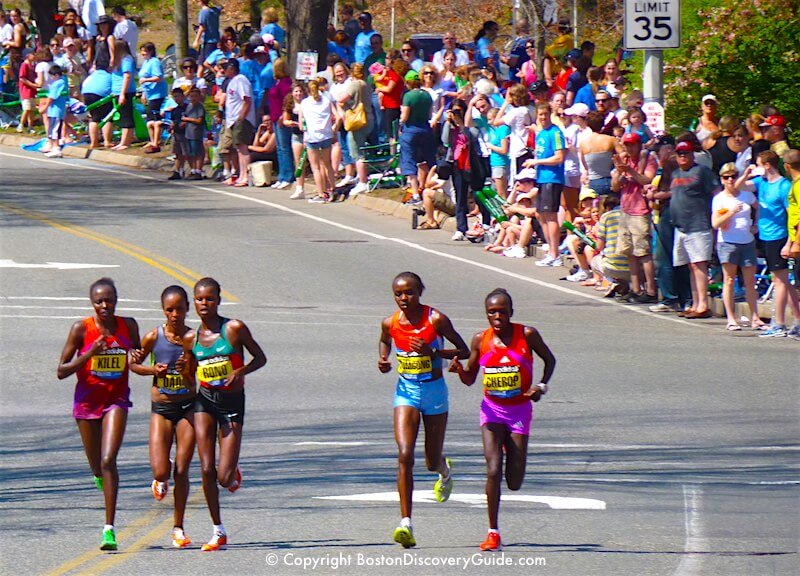
Unlike marathons held in flatter locations, hills define the Boston Marathon route. Runners particularly dread "Heartbreak Hill" located between Mile 20 and 21 in Newton.
Heartbreak Hill is the last of 4 hills in Newton which begin at Mile 16. Heartbreak Hill is not the steepest or highest hill along the course - in fact, it makes only an 88 foot ascent over a .4 mile stretch near Boston College.
If you walk - or even run - this stretch alone, you might think, "What's the big deal?"
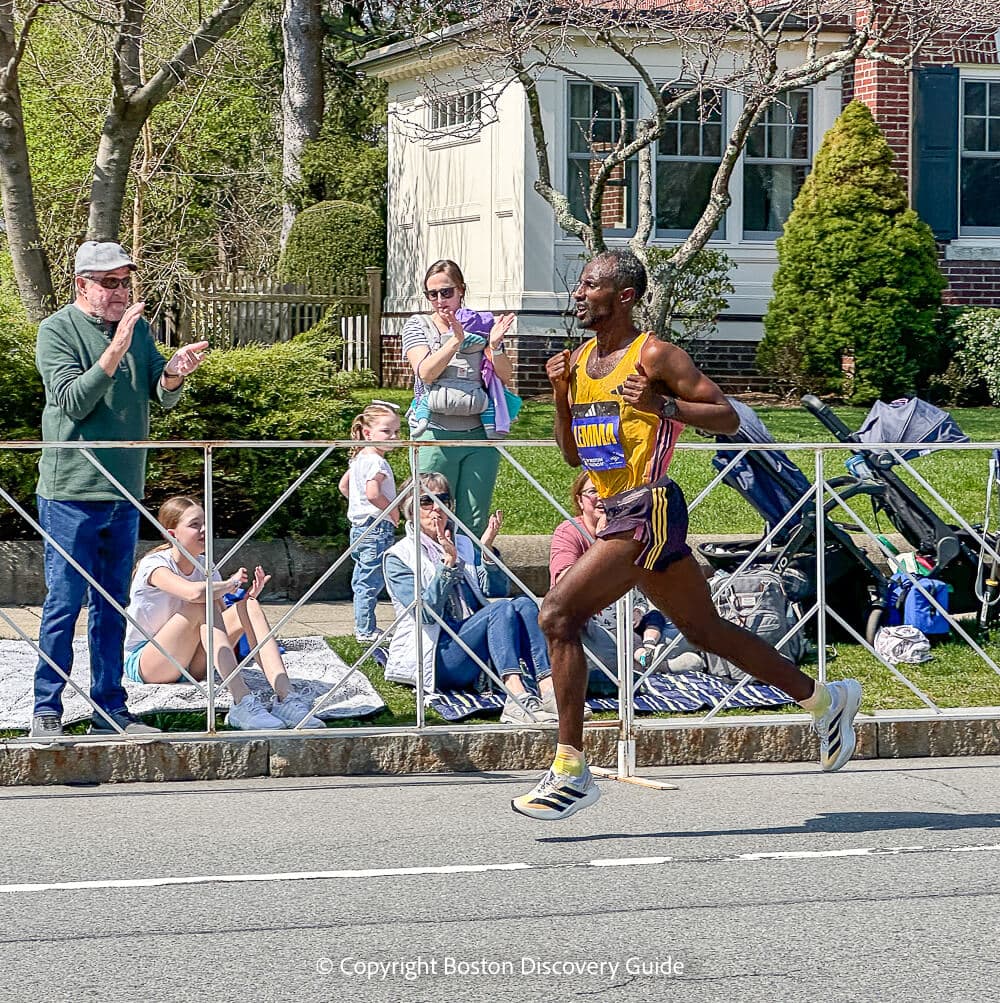
However, runners consider Heartbreak Hill to be the most challenging stretch of the course because it occurs so far along in the race, at a point when their energy and stamina is almost depleted.
And don't forget about the 3 other hills that come right before it.
Questions about the Boston Marathon? Check out what others have asked - or ask your own question.
Boston Marathon Race Start Times for 2026
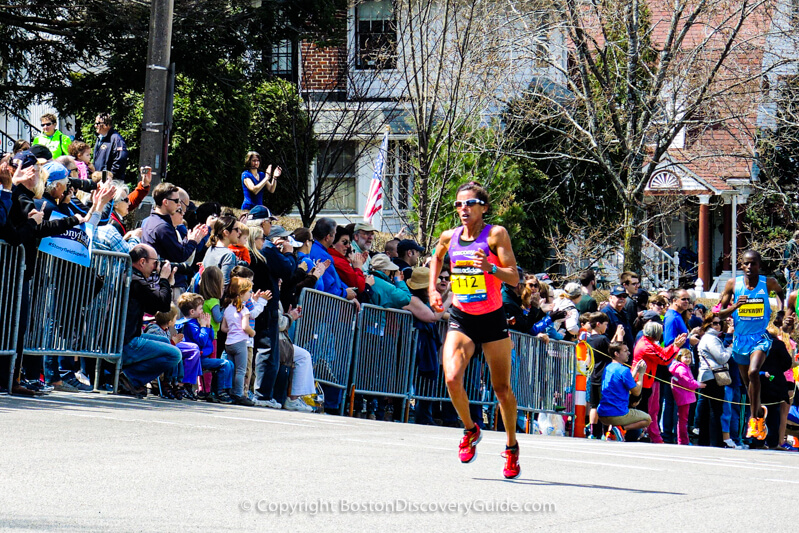
Boston Marathon start times are staggered and are based on the participant's division. Please note that start times differ from previous years. These are the start times for each division in 2026: (to be confirmed)
- Military March - 6 am ET
- Men's Wheelchair - 9:02 am ET
- Women's Wheelchair - 9:05 am ET
- Handcycles & Duos - 9:30 am ET
- Professional Men - 9:37 am ET
- Professional Women - 9:47 am ET
- Para Athletics Divisions - 9:50 am ET
- Rolling Start Wave 1- 10:00 am ET
- Rolling Start Wave 2 - 10:25 am ET
- Rolling Start Wave 3 - 10:50 am ET
- Rolling Start Wave 4 - 11:15 am ET
Please note that BAA always labels these times as "subject to change." Last-minute changes do occasionally occur, typically due to weather conditions.
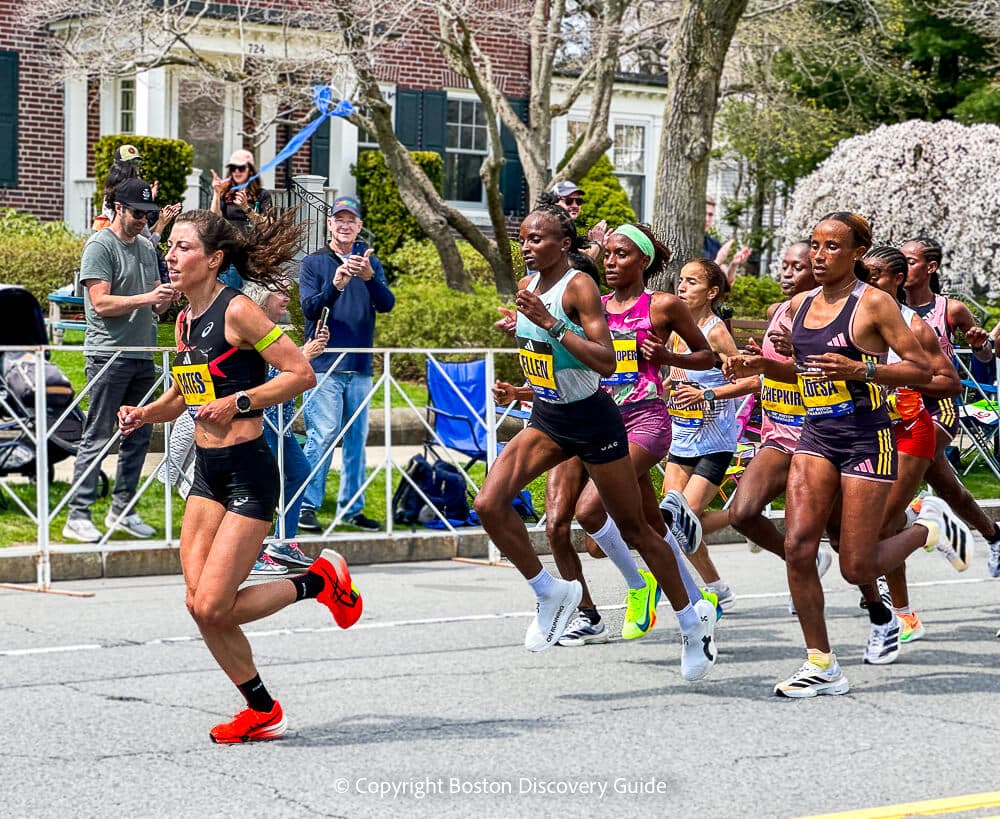
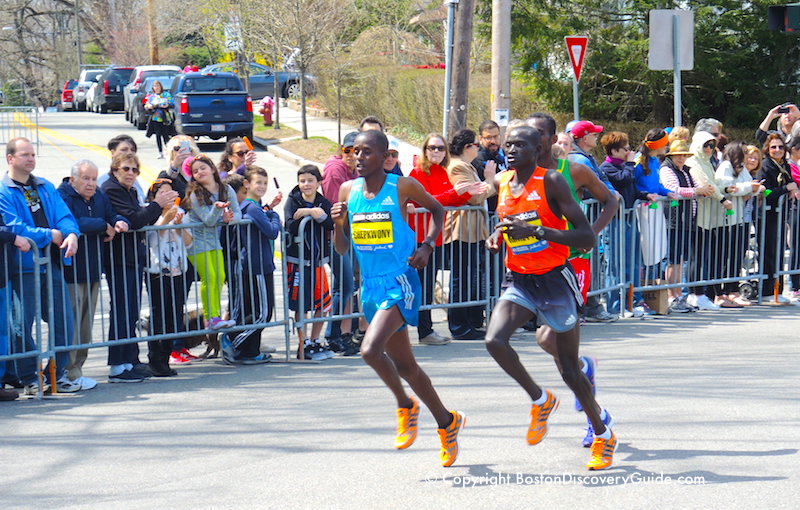
In the photo above, you can see runners at Mile 20 in Newton, where hilly terrain begins to separate the front runners from the rest of the pack.
The fastest runners finish in just over 2 hours. In other words, they reach the finish line at Copley Square shortly before noon. However, the race continues well into the afternoon.
In keeping with the democratic spirit, you'll see unofficial participants also running at least part of the race, even though this isn't technically allowed.
Some people do this just to see if they can. Still others do it just for fun. In recent years, some appear to be doing it for the photo opps.
The Marathon officially ends at 5:30pm, and Boylston Street usually reopens to traffic by 8pm, with other streets used by the race opening at about 7pm.
One reason for the Boston Marathon's prestige is that it is the only U.S. marathon with qualifying time standards. Participants must meet the qualifying times in order to participate.
Curious to know if you could qualify?
Find the Marathon's qualifying times
Boston Marathon Visitor Tips
- If you want to be anywhere near the finish line, walk or take the T.
- The Copley and Arlington T stations are closed on Boston Marathon Day as they are close to the finish line; you'll need to pick another station.
- If you take the T, get off at a station on the side of Boylston Street where you want to watch the race. You will not be allowed to cross Boylston Street, and underpasses will be jammed - so pick your station carefully.
- Do NOT drive into Boston on Marathon Monday. Streets are either gridlocked or closed, and Boston's Patriots Day Parade, which also takes place on Monday, adds to the congestion.
- Get a very early start if you want to find a parking space in a T parking lot. They fill up much faster than you might expect.
- Boston hotels typically fill to capacity during the weekend before the Marathon, and hotel rates soar significantly higher than usual. To get the best deal, make your Boston hotel reservations as early as possible. You can find Marathon hotel suggestions here, including a few where you can watch the race from your room.
- April weather in Boston is unpredictable, and so is Boston Marathon weather. Neither icy rain, broiling heat, nor wind storms deter the Marathon runners - but they may greatly diminish your viewing comfort. Dress in layers, and bring umbrellas and/or water bottles as common sense dictates. If you're not 100% committed to watching the runners, you may want to have a "Plan B" - so try these bad-weather alternatives.
Best Places to Watch the Boston Marathon
Depending on the weather, 500,000 or more people turn out to watch the race.
When the weather hits the "perfect" mark (ie, not too frigid, not sweltering hot, no sleet, snow, or torrential rains), the number of Marathon spectators easily soars to over a million.
Boston Marathon weather varies dramatically based on the year - find out more here
Our experience is that almost any viewing location along the route lets you experience the excitement of the race.
If you want to be near the finish line in Copley Square, be warned: crowds get huge and intense. Because of the massive number of viewers packed into a relatively small space, you will have only a slim chance of actually seeing the winners cross the finish line.
If you want to simply watch the runners, your best bet in the city is west of Kenmore Square.
Boisterous crowds gather around Boston University during most years, but plenty of more mellow venues can be found around the Chestnut Hill Reservoir near Boston College.
More Articles about the Boston Marathon
Here are links to all of our articles about the Boston Marathon
- Guide to the Boston Marathon - Everything you need to know
- Boston Marathon Route - What to expect & where to watch, mile by mile
- Boston Marathon Qualifying Times - See what it takes to qualify
- Boston Marathon Weather: What to expect
The Best Way to Get to the Marathon's Finish Line (As a Viewer, Not a Runner)
If you're planning to watch the Boston Marathon anywhere near the finish line, do NOT try to drive into the city. Many roads will be closed, traffic will be totally congested, and parking will be a nightmare.
Street closures and parking restrictions typically impact six central Boston neighborhoods: Back Bay, Beacon Hill, Brighton, Fenway/Kenmore, the North End, and Government Center.
If you're thinking you can drive into the city, park at some distance from the Marathon route, and then walk over, think again. Boston's Patriot Day Parade also takes place on Monday, kicking off from City Hall Plaza - so many streets in that part of the city will be closed.
Public transportation on the T (Boston's subway) is the only sane solution for getting there - but you'll need to do some careful planning.
The good news? The MBTA (T and commuter rail) gives you easy access to almost the entire Marathon route.
Branch C of the T's Green Line runs parallel to much of the course, and the Commuter Line's Framingham/Worcester Line has many stops within half a mile of the course.
Subway and Train Stations & Stops near the Boston Marathon Route
The closest T station to the finish line is the Copley station on the Green Line - but it will be closed for the day. Arlington station (Green Line, next to Boston Common) is also sometimes closed.
Other station closures include South Street (Green Line B) near Boston College, and Kent Street and Saint Mary's Street stations near Boston University. These three stations will be closed on Monday from about 10am - 6pm.
Aside from Copley (and Arlington, if/when it's closed), the other closest option to the finish line on the Green Line is Hynes Convention Center (Green Line/B, C, D trains), which is about a 1-2 minute walk to the race course and less than half a mile (normally about an 8 minute walk) from the finish line.
To the south of Boylston, Back Bay (3 short blocks; Orange Line and Commuter Rail) and Prudential (Green Line E) are good choices. Park Street on the Red Line (Boston Common) is also reasonably close.
Keep in mind that crowds of spectators as well as security measures may make walking take a little longer than usual, especially in areas near the finish line.
A bit farther to the west, Green Line/Fenway is a decent choice.
If you want to be near Boston University - always a lively spot - take any of the Green Line B exits (except for Kent Street and St Mary's Street, as noted above) near BU, such as Blandford Street or BU East, BU Central, or BU West.
Because Monday is the Patriots Day holiday throughout Massachusetts, parking in metered spaces is free - but good luck finding any open spots that aren't Residents Only (and no, you can't park in those unless you want to be ticketed and yes, in case you're wondering, you probably will be).
Many streets will be closed on both Saturday, when a couple of short races take place, and Monday, the day of the Marathon and Patriots Day Parade.
To see a complete list of road closures and parking restrictions, check the City of Boston's website and click on the link at the top of the home page (if you don't see it, check back within a week or two of the Marathon).
To ease your commuting effort and expense, the MBTA will run additional trains and Silver Line buses on Marathon Monday, plus MBTA's $10 Weekend Pass, normally good only on Saturdays and Sundays, will also be valid on Patriots Day.
You can also save with regular subway (T) and bus 1-day and 7-day passes:
- $10 Commuter Rail Holiday Weekend Pass - Good for unlimited travel within all zones on all commuter rail lines. (The Worcester Line, which runs parallel to the Marathon route, has numerous stops less than 1/4 mile from the course and others within half a mile.) Buy the mTicket Holiday Weekend Pass on MBTA's "mTicket" app, at ticket wondows at North, South, and Back Bay stations, and also onboard with cash or credit. Find all the details on the MBTA website.
- 1-Day T (Subway) Pass for $11 - Buy it at any fare vending machine in a T station - Good for 24 hours, starting as soon as you purchase it. Don't rush to buy this, though, if you plan to use only the T until you calculate how many trips you'll make in one day. Each 1-way T ticket costs $2.40, so this pass makes sense only if you expect to make 4 or more trips on one day. Boston is quite compact and mostly flat, which makes it ideal for walking.
- In Boston for a week? Buy a 7-day pass for $22.50. You can get them at fare vending machines in subway stations, and they're valid for the T (subway), local buses, the Silver Line (which connects with Logan Airport), Zone 1A of the Commuter Rail, the Charlestown Ferry (fun to take if you have some extra time), and the seasonal East Boston Ferry.
More about Boston's subway system & fares
MBTA Maps Showing Stations near the Finish Line and nearby Race Course
This map from the MBTA shows stops and stations closest to the Marathon route:
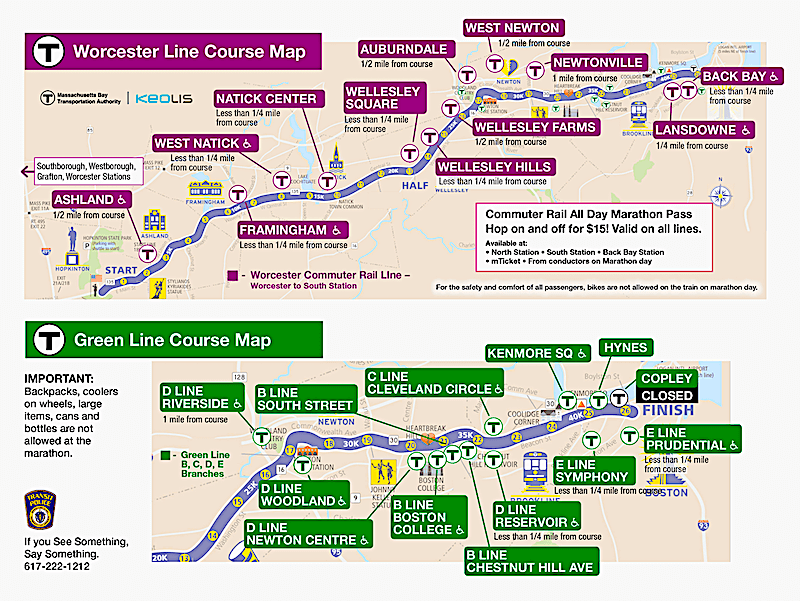
As you can see on the map (and as previous mentioned), the Copley station will be closed during the race, but as noted above, others will be too.
Why is the Marathon Called the "Patriots' Day Race" in Boston?
The Boston Marathon has taken place every year since 1897. Initially, runners ran on or just after Patriots' Day, a Massachusetts holiday that celebrates the battle on Lexington Green and Old North Bridge in Concord on April 19, 1775, marking the official beginning of the American Revolution.
Here in Boston, many people continue to call the Marathon the "Patriots' Day Race."
In 1969, Patriots' Day started to be officially celebrated on the third Monday in April, and the Marathon shifted to this day as well.
Because Patriots' Day is an official Massachusetts State holiday, most state, county, municipal offices, and schools are closed - which helps alleviate some of the commuter traffic into Boston and enables more people to watch the race.
See the Patriots Day events schedule
Marathon Man Statue - John A. Kelley
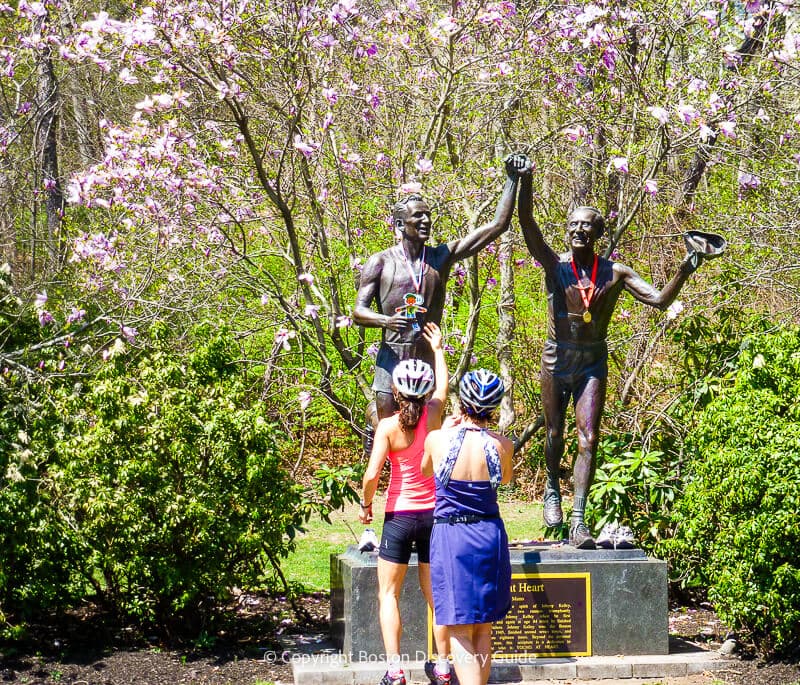
The "Marathon Man" statue near the beginning of Heartbreak Hill, just north of Commonwealth Avenue at the Walnut Street intersection, commemorates Boston's legendary world-famous long distance runner, John A. Kelley, who ran 61 Boston Marathons before his death in 2004 at age 97.
Kelley won the Boston Marathon in 1935 and 1946, and represented the U.S. at the Summer Olympics in 1936 and 1948.
The statue depicts two smiling runners joining hands in a triumphant gesture. On your left, as you face the statue: Johnny Kelley at age 27 after he won his first Boston Marathon. On your right: Kelley when he ran his last full Marathon at 84.
At the base, a plaque explains that the statue represents "everyone who is young at heart."
Boston Marathon Memorials
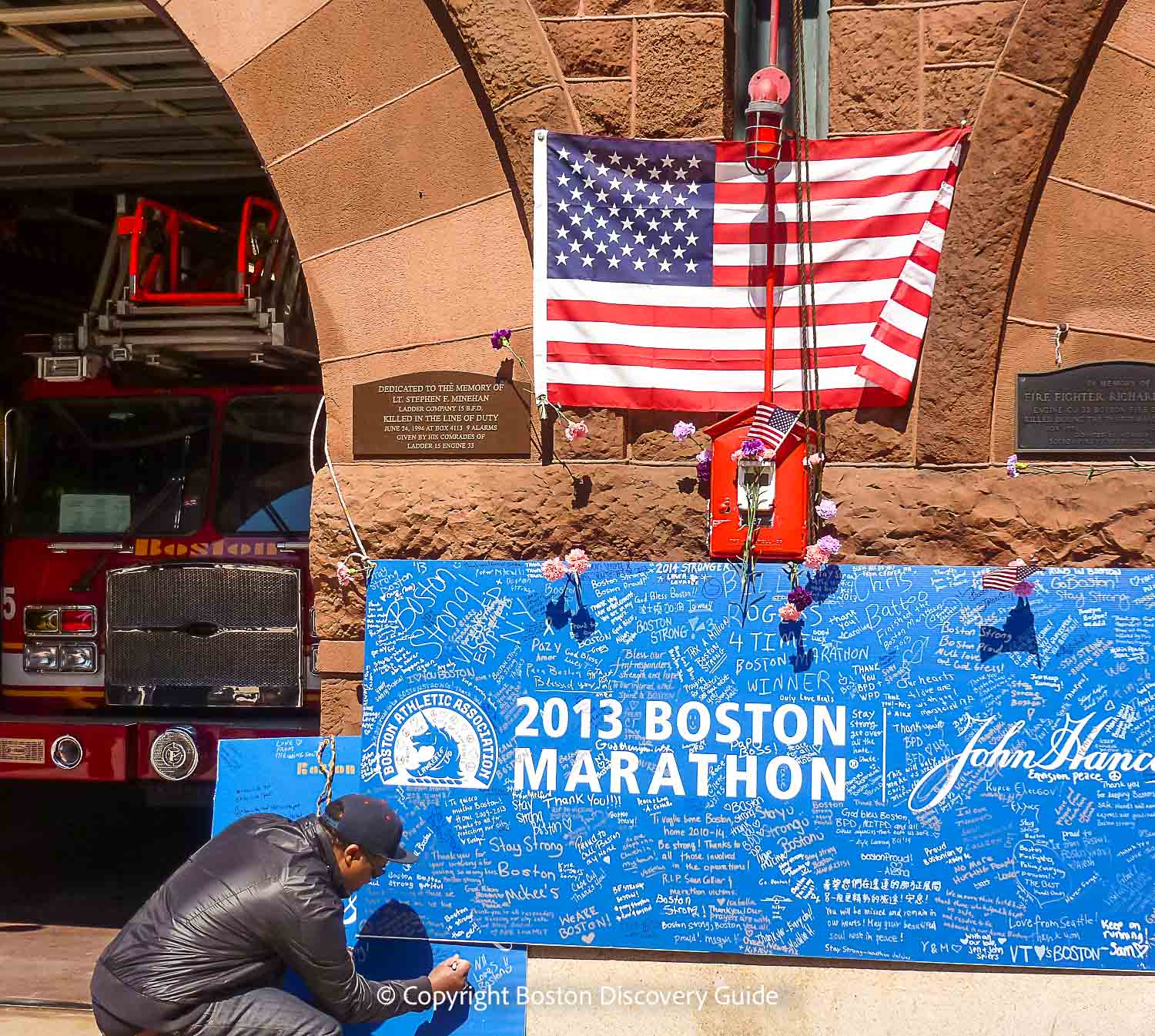
During the 217th Marathon in 2013, two bomb explosions near the finish line ripped through the heart of our most iconic Boston event.
The outpouring of support from around the world at a pop-up memorial in Copley Square was heart-warming during a very difficult period in Boston.
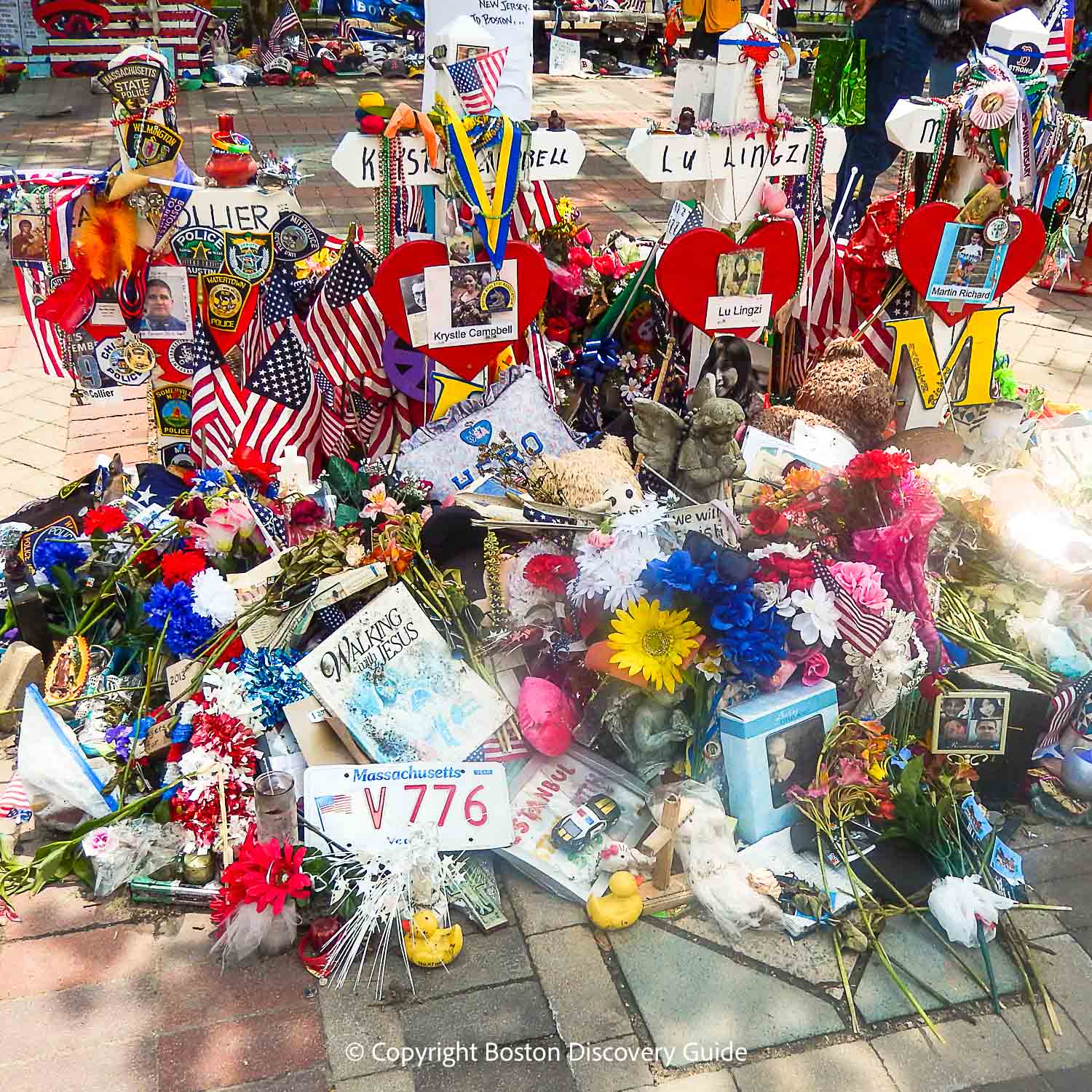
We will never forget.
Boston Strong!
One Boston Day
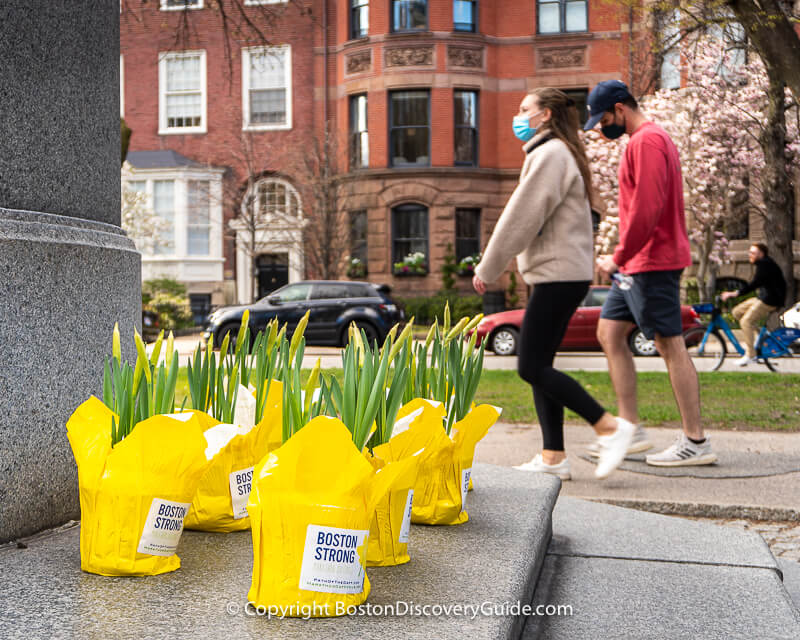
One Boston Day marks the anniversary of the Boston Marathon Bombings and grew out of a desire by the survivors to thank the first responders, medical staff, and random strangers who cared for them, and to "celebrate the resiliency, generosity, and strength demonstrated by the people of Boston and those around the world in response to the tragedy of April 15th, 2013."
One Boston Day usually takes place two days before the Marathon, and is dedicated to random acts of kindness, spreading goodwill, unity - and honoring "Boston Strong."
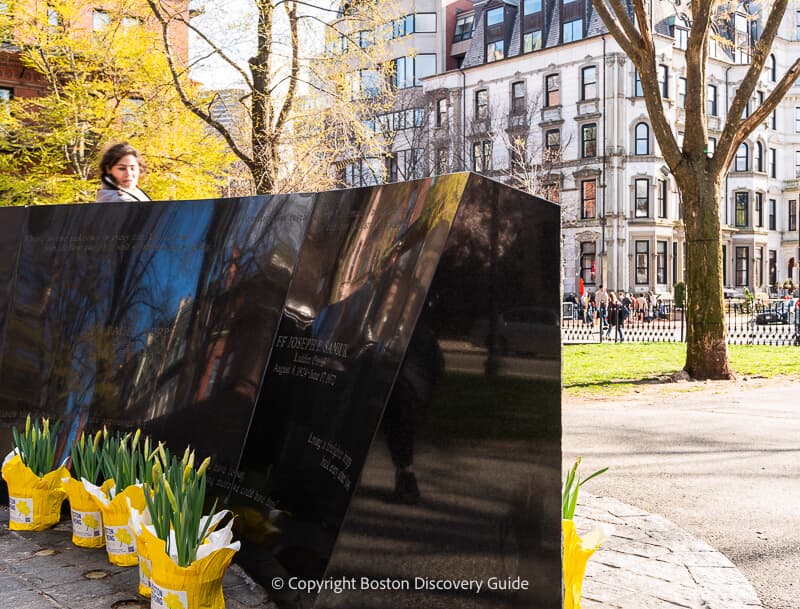
A special ceremony marks the two spots on Boylston Street where the bombs exploded.
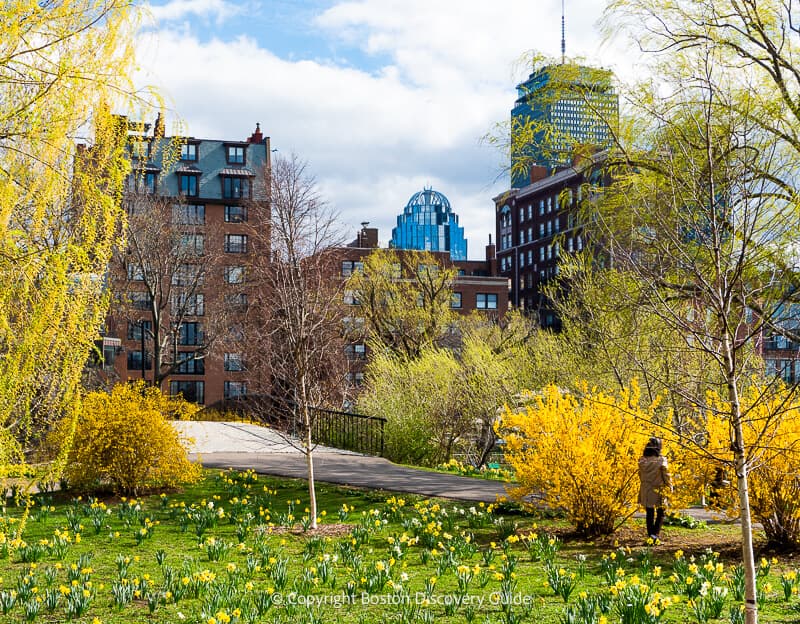
In recent years, yellow daffodils have been placed along sections of the Marathon route, as well as other locations throughout the city.
Boston Marathon Hotels
Need a hotel for the Boston Marathon? Just enter your dates below, and see available rates and hotels on this hotel map from Booking.com:
Fun Ways to See Boston during Marathon Weekend
More Articles about the Boston Marathon
Find more of our articles about the Boston Marathon:
- Boston Marathon Route - Mile-by-mile description about what to expect if you're running and including best places to watch if you're a spectator, plus a map
- Boston Marathon Qualifying Times - See what you need to achieve to qualify
- Boston Marathon Weather - What weather conditions might happen on race day (you may be shocked), and tips about training for our weather
- Best Boston Marathon hotels - For runners and watchers
Popular Boston Tours & Cruises

HOLIDAYS & TOP EVENTS


Whale Watching Cruises
Hop On Hop Off Trolley