
Driving in Boston is not for the faint-hearted.
If you're planning to visit and drive in the city, use these Boston driving tips to get a flavor of the city's driving and pedestrian culture. You'll have a safer, saner, and and pleasanter experience!
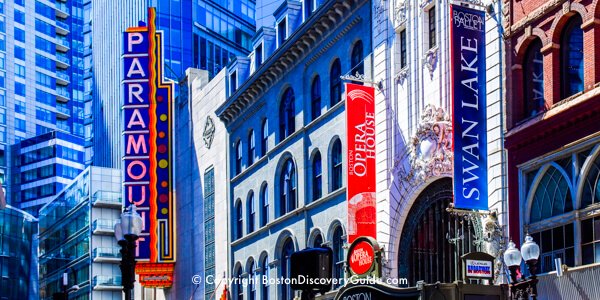
Top photo: Boston rush hour traffic on Stuart Street in the Theatre District, (c) Boston Discovery Guide
Boston Discovery Guide is a reader-supported publication. When you buy through our links, we may earn a commission at no additional cost for you. Learn more
Why Are these Driving Tips Necessary?
Streets in the oldest parts of Boston were laid out during Colonial times.
You may be tempted to believe that the streets follow random cow paths from the old days - but that's not totally true.
Puritans carved out lanes around rocky outcroppings, hilly areas, and coves as they drove their cattle from the "common" - what we now know as Boston Common - to the town spring located near the intersections of current-day Water Street, Devonshire Street, and Spring Lane.
Their descendents hauled away the rocks, leveled the hills, and filled the coves - but the narrow, winding streets remain.
And then there's the congestion. Central Boston is small and compact - great when you're walking, but a nightmare when filled with cars, bicycles, and pedestrians, all vying for the same space while going in different directions.
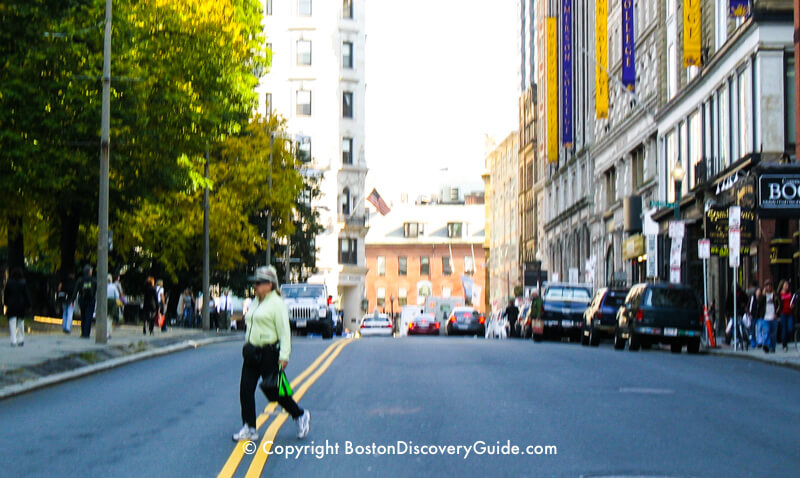
Ah, the pedestrians . . . Boston is full of them, since walking is usually the easiest and fastest way of getting around.
Boston pedestrians embrace a culture of jaywalking - sometimes rather aggressively. If you're driving, you must anticipate that we will step out right in front of your car - and expect you not to hit us!
At the same time, you need to watch out for bicycles and bike lanes.
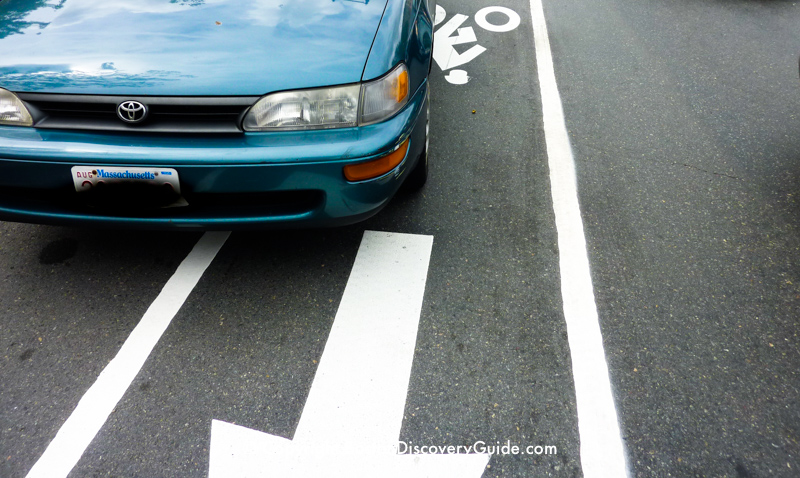
Boston streets can be hazardous for bicycle riders, in part because many streets don't have bike lanes - they're already too narrow. Where bike lanes do exist, some car drivers pull into them to make right hand turns, others double park in them, and still others use them as very narrow driving lanes.
Additionally, pedestrians, cyclists, and drivers routinely disregard traffic signals. This is normal in Boston, and if you're visiting, you need to get used to it.
But if you're from a place where drivers, walkers, and bike riders normally obey traffic signals and cross streets only at corners, you may find Boston's street anarchy a little unnerving.
That's why we're sharing our driving tips. You're welcome!
14 Tips for Safer Driving in Boston
Yes, 14 driving tips does sound excessive - but trust us, you'll need them.
Boston Driving Tip #1: Don't!
That's right - don't drive in Boston if you can possibly avoid it. Seriously.
By not driving, you'll avoid stress as well as hefty parking fees. It's also better for the environment.
Walk or use Boston's subway or water taxis instead, especially if you're planning to visit our enticing bars or clubs - much better than calling a Boston DUI attorney.
Boston Driving Tip #2 : Going to drive in Boston anyway? Don't risk smashing up your own car . . .
Rent a car, and sign up for all the rental car insurance you think you might possibly need (of course, first check your own insurance coverage for rental cars to make sure you're not paying double).
Boston streets are narrow, parking spaces are small, and streets spend the winter developing enormous potholes that usually don't get fixed before late fall. Why risk wrecking your own car? And driving up your own rates by making a claim?
Find out about Zipcar rentals in Boston
Boston Driving Tip #3: Get the smallest rental car possible
Remember the narrow streets and small parking spaces?
You'll be happier with a smaller car. Much, much happier. And you'll save money.
Boston Driving Tip #4: Rent a car for the shortest time possible
Here's another way to save money on a car rental and parking while you're in Boston (assuming that you absolutely must have a car): unless you need a car for your entire visit, rent one for just the days or hours you'll need it.
Boston Driving Tip #5: Park your car outside of the city
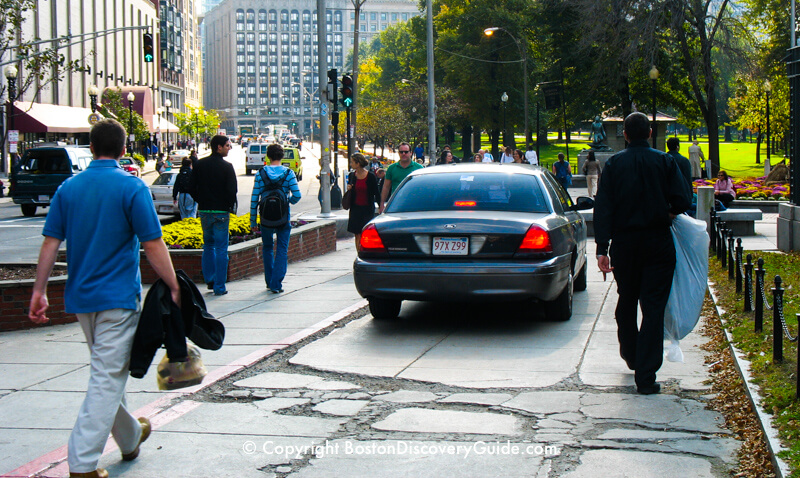
If you're driving to Boston but won't actually need a car while you're here, you can save a ton of money and avoid the hassle and potential liabilities of driving in Boston by parking your car at one of the Boston subway stations that allow overnight parking (go to the MBTA's website at www.mbta.com and click on "parking" to find a list).
Park your car in the lot, grab your suitcase, and ride the T (Boston's subway) to your hotel. Overnight parking costs about $8 at most of the stations where it's allowed - much, much better than the $50+ that some Boston hotels are now charging.
Plus, taking the subway to your hotel is usually easier and faster than driving in the city.
Boston Driving Tip #6: If someone gives you directions, be aware that they may use names that no longer appear on maps . . . and maybe never did
For example, if someone mentions "Prison Point Bridge" when telling you how to drive from Cambridge to Charlestown, you've just heard the historical name for the overpass where Land Boulevard (usually called "Memorial Drive," the name of the road along the north side of the Charles River before it morphs into Land Boulevard) near Route 28 (locally called "O'Brien Highway") and Route 93. Famed Boston architect Charles Bulfinch designed a prison built near here in the early 1800s - now long gone.
Similarly, someone may give you directions that involve crossing the Charles River on the "Saht and Peppa Bridge" (said without a Boston accent, that would be the Salt and Pepper Bridge). This is actually the Longfellow Bridge (Route 3, a.k.a. Cambridge Street), originally called the "West Boston Bridge," but "Salt and Pepper" is the colloquial name because its towers resemble salt and pepper shakers.
Think you'll rely on GPS? ROFL. GPS is not always accurate for Boston. Actually, in certain situations, it's usually not accurate. Read on . . .
Boston Driving Tip #7: Don't expect your GPS to be accurate
GPS is a huge help for most driving situations...but not always in Boston. Sure, GPS will help you get to Boston and will usually get you to the general vicinity you're trying go, but it can lead you seriously astray just as you think you're about to reach your destination.
Why?
The biggest headaches involve one-way streets. GPS often doesn't detect them. That means that if you follow the GPS directions, you'll be going the wrong way - always dicey.
Closely related are places where you can't turn left, or right, sometimes because the street is one-way in the opposite direction but other times simply for mysterious reasons known only to the Boston Road Gods. Since GPS can't read the mind of a BRG, you'll be told to turn. GPS also fails to detect the police officer who will pull you over after you've made the turn.
Then there are all the other stump-the-GPS Boston road conditions...multiple streets with almost the same name, streets bisected by a park or building that fails to show up on the GPS (like you're supposed to drive straight through it?), and streets that change names every block or two.
We could continue - but you get the idea. Don't expect GPS to be accurate, especially for the "last mile," - and don't make turns (or do anything) that the GPS tells you to do without also checking signs. And possibly a real Boston map.
Boston Driving Tip #8: Traffic signals are just a suggestion
A red traffic light has a universal meaning, right? Other drivers and pedestrians stop when they see it? Ditto for stop signs?
Um . . . wrong. Not in Boston. Some drivers do stop, while others speed up. Still others will be too busy texting or shaving to notice the traffic signal.
In order to leave Boston alive, you must always drive defensively. EXPECT THE WORST.
Boston Driving Tip #9 Don't expect to see turn signals every time a driver's going to turn
If you're from another part of the U.S. or another country, you may be accustomed to seeing those little flashing lights on backs of vehicles that tell you another driver is planning to make a turn.
They have a slightly different meaning here in Boston. Here, a turn signal means the driver plans to make the turn whether or not other cars happen to be in the way. Turn signals are reserved for those "I'm gonna be fired if I'm late to work one more time" or "I need caffeine NOW" or "Just heard the Sox are winning, gotta go celebrate" emergencies.
Other Boston drivers understand these needs, and accommodate.
What about all those drivers who don't signal? Well, they're still going to turn, and you're expected to know that and not hit them.
The good news is that with no dire emergencies involved, everyone can maneuver their way through the intersection all at once - no need to take turns.
Boston Driving Tip #10: Expect cars to cross lanes of traffic as they turn
Remember the fairly basic, common sense rule about making right turns only from the right lane, and left turns only from the left lane?
If so, you may be the only person here in Boston who remembers this.
Or maybe Boston drivers do remember the rule, but don't care.
In any case, you need to approach every intersection knowing the car to your right may suddenly cut in front of you to make a left-hand turn - usually without using a turn signal.
Yes, this is quite dangerous - but that's how it is, so if you drive here, beware . . . especially because this trend has really caught on as road congestion gets worse and frustration rises.
Boston Driving Tip #11: Watch out for "easing out"
"What is easing out???" you may well be wondering.
"Easing out" typically happens on roads with faster-moving traffic, such as Storrow Drive and Route 1. "Easing out" occurs when a driver wants to move into the road from a parking lot exit or even from the break-down lane and pulls slowly into the right lane ahead of on-coming traffic without looking at the cars rushing toward it.
This maneuver is based on a heart-felt belief that if you don't make eye contact with other drivers, they don't exist.
As the driver of one of the faster-moving vehicles, you're supposed to anticipate that a car may "ease out" right in front of you, and you're expected to avoid hitting it. Because if you do hit it, the accident will be your fault.
Boston Driving Tip #12: Beware of pedestrians
Although jaywalking is illegal if a crosswalk is less than 300 feet away, the fine for jaywalking in Boston is only $1, although it does rise to $2 after 3 violations within a single year.
Drivers must yield to pedestrians in crosswalks, marked or unmarked. (Please don't ask us what an "unmarked" crosswalk is. We have no explanation.)
You also should be equally careful to not hit pedestrians even if they're not in crosswalks, as many will not be.
Police officers do respond to jaywalkers: often, they stop the traffic so that the jaywalker can cross safely.
Now frankly, this is a nice thing about living here, especially when you're the jaywalker. It's sort of like a scene right out of Make Way for Ducklings - but with jaywalking humans instead of baby mallards being helped across the street. It's part of what makes Boston a civilized place to live, and if you're a jaywalking out-of-towner, a sweet place to visit.
But if you're driving . . . watch out!
More Ways to Get Around Boston
Boston Driving Tip #13: In rotaries, assume the other drivers have the right of way
Boston, and for that matter, much of Massachusetts, has rotaries - circular road junctions where typically (but not always) cars go only counterclockwise, entering and exiting whenever they think they can do so without hitting or being hit by another car. In other parts of the U.S. except for Rhode Island, they're usually called "round-abouts."
The idea is that rotaries allow cars to go through intersections faster than they could if they had to stop. This is probably true, especially in larger diameter rotaries where you can pick up a lot of speed while driving in a circle.
Fortunately, traffic signals now make most rotaries in central Boston slightly safer (Leverett Circle between Beacon Hill and the West End is an exception to this when traffic moves faster than 3mph, which fortunately seldom happens). If you drive outside of the city, you are likely to encounter many more rotaries.
Ask any group of Boston locals, "What are the rules about who has right of way in a rotary?" and they'll say, "Rules? For a rotary?!?"
Or, even worse, each person will describe rules - but each one will tell you something totally different.
The Massachusetts Department of Motor Vehicles actually does publish rules for rotaries (short version: drivers already in the rotary enjoy the right of way). You can read the rules for yourself in the DMV manual (search for "Drivers Manual" and see Chapter 4, Rules of the Road). But bottom line, you need to expect that no one else knows what the rules are, or if they think they do, they're probably wrong.
Your best bet?
Always give the other drivers the right of way, especially if they look like they're going to take it in any case. This is not the moment to prove how you're right and they're wrong.
And if you see a car, usually with out of state license plates, going clockwise - in other words, the wrong way - in a rotary, don't even think about entering until the other car safely exits.
Boston Driving Tip #14: Assume the best about other Boston drivers
Boston drivers have a reputation for being rude, aggressive, and some other namees we probably shouldn't use in a public website.
But once you drive here for awhile, you may observe that Boston drivers are generally courteous, good-humored in situations such as tight jams in parking spaces, and forgiving when one goes the wrong way down a 1-way street and has to back out or make a sudden emergency u-turn. After all, most local drivers have been in those situations themselves.
So why the reputation for rudeness? Probably the disregard for traffic lights, stop signs, and traffic rules. What comes across as rudeness or aggression to someone from a part of the country where drivers actually obey traffic rules may just be the normal, good-humored local anarchy on our roads.
Which gets back to Driving Tip #1: if you don't have to drive in Boston, don't!
Fun Ways to See Boston without Driving
More Articles about Boston Transportation & Sightseeing
- Parking in Boston - Where to park without spending a huge fortune
- Cruise from Boston to Provincetown - How to get to the Cape FAST by ferry
- Whale Watching Tours - Get an up-close view of whales and other marine life
- Coming to Boston from NYC? Take the Bus
- Boston Cruises - More ways to see Boston by water
Need a Boston Hotel or Apartment?
Use this handy map from Booking.com to find the perfect place to stay. Just enter your dates to find what's available, see the best rates, and make your reservations.
Booking.com