
What are the key events in Boston history? And why should you care?
Almost 400 years have passed since the first group of English Puritans set foot on the small peninsula that they named "Boston" and built into one of America's biggest and best cities.
During those 400 years, Boston has led the nation in fighting for independence, in establishing great civic institutions, and finally in rejuvenating city neighborhoods.
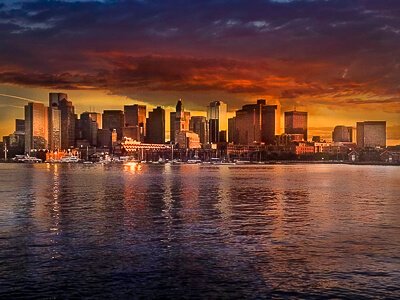
Millions of people visit Boston each year to experience its top attractions, excellent hotels, and renowned restaurants.
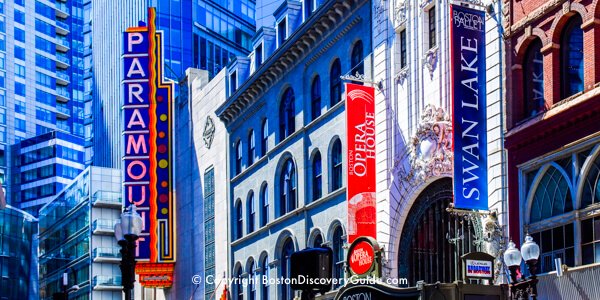
Old red brick buildings blend seamlessly with the soaring steel and glass business towers of today.
Walk around the city and you'll see evidence of Boston's history everywhere.
But who even knows the difference between a Puritan and a Pilgrim? What things happened first in Boston? And why did Red Sox fans once moan about the "Curse of the Bambino?"
You can certainly enjoy Boston without knowing any of these things.
But in case you're planning a visit and want to learn more, use this Boston history timeline to find out how our spectacular 21st century waterfront city began, grew, and flourished.
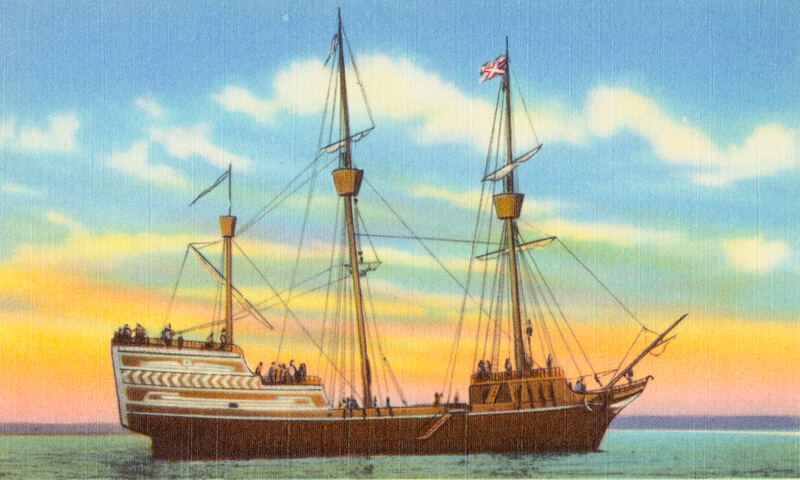
Top Photo: Representation of The Arabella (also called Arbella), one of 11 ships that carried about 700 Puritans and their livestock and other possessions to the New World in 1630 (Photo source: The Tichnor Brothers Collection, Boston Public Library, public domain)
Boston Discovery Guide is a reader-supported publication. When you buy through our links, we may earn a commission at no additional cost for you. Learn more
1630 AD: The Puritans Arrive
Did Boston's history begin with the Puritans' arrival?
No, not by a long shot. In the almost 10,000 years before their arrival, melting Ice Age glaciers formed New England's landscape, Native Americans arrived ... and that's just the beginning.
1631 - 1680: Puritans Build Boston
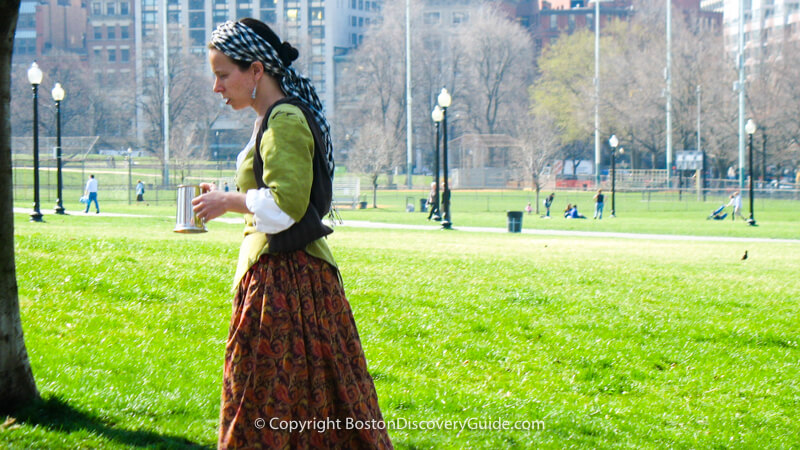
After a rough beginning, the Puritans begin to prosper and build.
Find out about how they laid the foundations for what makes our city great today - schools, parks, libraries, taverns - and find out why Boston history has so many "firsts." in the New World.
Learn more about how the Puritans build Boston
1681 - 1760: Massachusetts Bay Colony
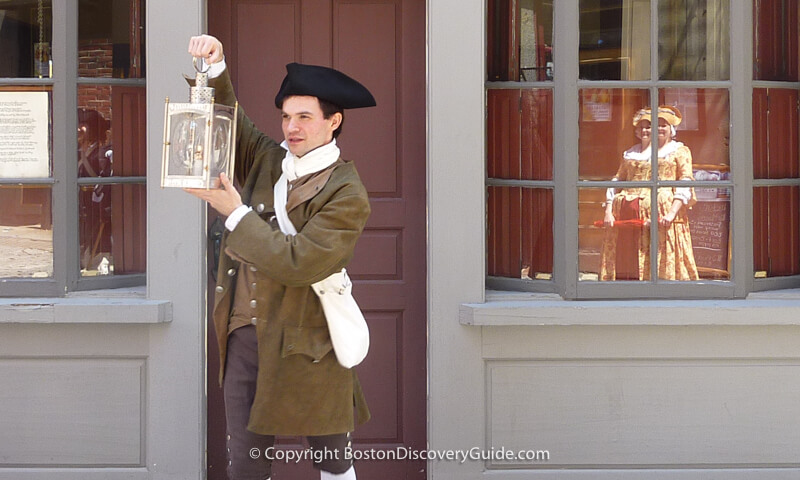
The English monarchy is restored ... and trouble descends on Boston as the Massachusetts Bay Colony loses its right to self-govern.
Discover why the Colony and Boston begin to revolt by 1750 - even though the Revolutionary War is 25 years away.
Find out more about troubles in the Massachusetts Bay Colony
1761 - 1772: "No Taxation without Representation!" & The Boston Massacre
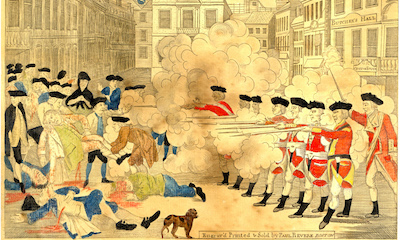
British rulers lust for taxes and control ... and resistance by the Colonists grow.
When British troops fire into a hostile crowd and kill 5, anger explodes and revolution fills the air. Discover why "No Taxation without Representation" can be heard throughout Boston by 1750.
Learn more about why the Colonists opposed taxation without representation
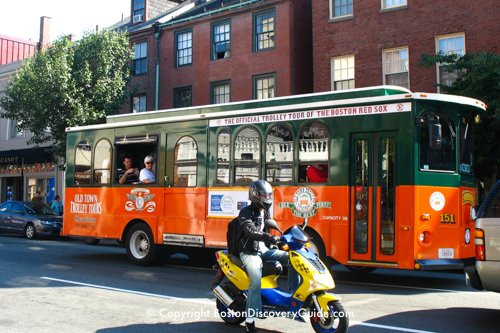
Tours through Boston's History
1773 - 1774: Boston Tea Party
When the king sends ships full of English tea to Boston and blockades the harbor to force the colonists to unload the cargo and pay taxes, Patriots Samuel Adams and other Sons of Liberty decide to hold a Tea Party - in Boston Harbor.
To retaliate, the Redcoats move the state capital to Salem and occupy Bostonians' houses.
Read about the Boston Tea Party - and the Redcoats' revenge
1775: American Revolutio
n Begins
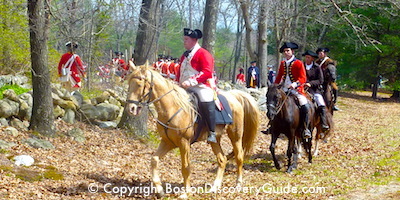
On the evening of April 18, Paul Revere and William Dawes set forth on horseback to warn that British troops are coming to Concord to try to capture John Hancock and Sam Adams.
On the following day in Lexington, an important day in Boston history unfolds as shots ring out and the American Revolution begins. A few months later, the Battle of Bunker Hill rages.
Find out about Paul Revere's midnight ride - and the first bloody day of Revolution
Patriot Profile: A Menotomy Hero
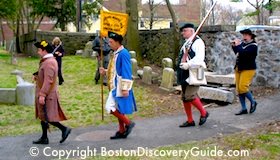
Samuel Whittemore fought three times for the British, and moved from England to the Colonies.
Now he's settled down on his farm outside of Boston. When he sees British militia moving across the countryside, he grabs some weapons. He wants his grandchildren to grow up free, and he plans to do his part. He is 81 . . . but not too old to fight!
Learn more about the life of Sam Whittemore
The Midnight Ride of Paul Revere
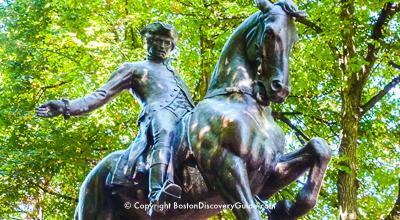
Longfellow wrote "The Midnight Ride of Paul Revere" almost 100 years after the fateful gallop across the countryside.
It's not quite accurate - but he captures the courage of the women and older men left to defend their farms, and he gives us the memorable line, "The British are coming!"
A Rousing Poem: "The Midnight Ride of Paul Revere"
1775 - 1799: The Siege of Boston
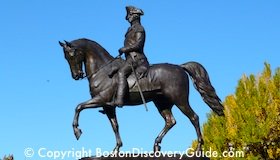
With Boston in a state of siege, General George Washington expels the British from Boston on March 17, 1776.
Within a few years, Bostonians celebrate Independence, write the Massachusetts State Constitution, sign the U.S. Constitution, and join the Federal union. Massachusetts becomes the first state to abolish slavery.
More about the Siege of Boston
1800 - 1849: Industry, Immigrants, Abolition
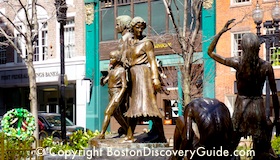
A different type of revolution - the American Industrial Revolution - begins when Bostonian Robert Cabot Lowell builds the nation's first textile mill. Boston becomes a city.
The City of Boston grows by annexation and by filling mudflats to create land as Irish and other immigrants swell the population. Anti-slavery speeches heat up, putting Boston at the center of a growing national debate.
1850 - 1899: Boston Grows and Flourishes
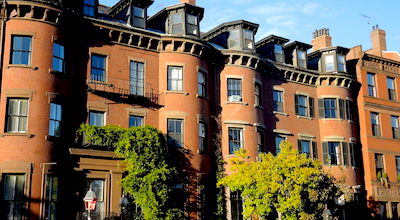
Annexation, land fill, and Irish immigration continue. Massachusetts fights to preserve the Union in the Civil War.
Many of Boston's great cultural institutions form and flourish. Back Bay is built and literature blooms - but in a dark moment in Boston history, three Harvard graduates found the Immigration Restriction League to ban immigrants from countries they perceived as "inferior."
The first Boston Marathon takes place.
1900 - 1949: Curses and Disasters
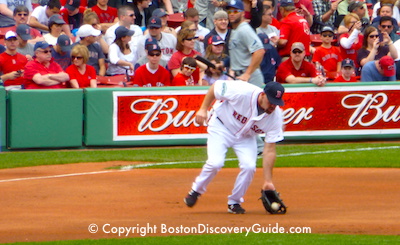
The Boston Pilgrims, soon to be known as the Boston Red Sox, win a world series but all too soon comes a dreadful moment in Boston history: Babe Ruth places the Curse of the Bambino on the city, causing generations to despair.
The Cocoanut Grove fire kills 490.
Threatening clouds gather over Boston after World War II as a slow decline begins.
A Gruesome Event: The Great Molasses Flood
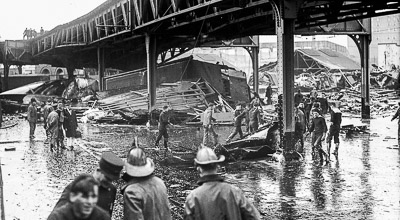
The Great Molasses Flood - perhaps the ghastliest event in Boston's history - occurs when exceptionally warm January weather causes a huge, already-leaking vat of molasses to burst in the North End.
The ensuing flood of what witnesses describe as "goo" kills 21 people plus a number of animals.
Find out more about the Great Molasses Flood
1950 - 1999: Boston's Decline ... and Revival
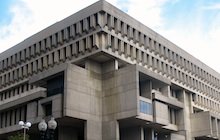
Urban renewal fervor razes the West End and brutalist-style Government Center is built.
The elevated Central Artery goes up, bisecting the city. "Dirty Water," the Standells' pop song, immortalizes the then-polluted Charles River.
John F. Kennedy is elected U.S. President, and assassinated 3 years later.
Finally, urban regeneration begins to revive the city.
2000 - Present
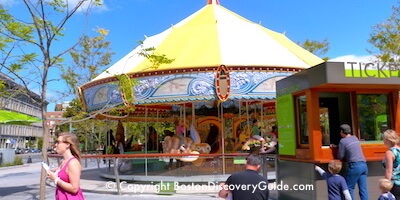
The Central Artery becomes a tunnel covered by a new park, the Greenway, to reunite the city.
Massachusetts leads the nation in legalizing same-sex marriage and enacting healthcare reform.
The Red Sox reverse the Curse and win two World Series. Celtics, Bruins, and Patriots also win championships.
Quarterback Tom Brady, locally known as "G.O.A.T" ("Greatest of All Time) leads the New England Patriots to 6 Super Bowl wins during his 20-year tenure with the Pats before departing to join another team.
117th Boston Marathon Bombings: Boston Strong
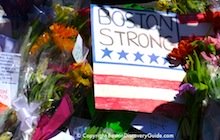
Two bombs explode near the finish line of the 2013 Boston Marathon. After a massive manhunt, the police find the two suspects. One accidentally kills the other before surrendering. Boston Strong becomes the city's mantra.
See Boston Discovery Guide's photos of the 117th Marathon Memorials
More Articles about Boston History
- Boston's Freedom Trail - Walk along Boston's path through history
- Books about Boston - The best books about Boston to read before and after your visit
- Boston Sightseeing Tours - See the best of Boston
Need a Boston Hotel or Apartment?
Use this handy map from Booking.com to find the perfect place to stay. Just enter your dates to find what's available, see the best rates, and make your reservations.
Booking.com