

Ready to take an unforgettable walk through Boston's history?
The red stripe marking the Freedom Trail stretches for 2.5 miles (4 km) through Boston's most historic neighborhoods, and takes you to 16 sites important to the founding of Boston and the birth of American liberty.
Walk along the Trail, and you'll see and visit historic buildings (some are now museums) and sites, famous churches, meeting houses, a centuries-old market place that's still a lively shopping and entertainment center, burying grounds, a battle ship, and a park once used by British troops and Colonial militias.
Not surprisingly, the Freedom Trail is Boston's most popular tourist attraction.
Boston has more sites related to the American Revolution and America's fight for independence than any other city.
As you walk along the Trail, you'll travel through a variety of neighborhoods: Historic Downtown Boston, the North End, and Charlestown, from Boston Common to the Charlestown waterfront.
All Freedom Trail sites are authentic - not re-creations or reproductions - so you'll see Colonial and Federal architecture, plenty of old tombstones, and a medieval-style house dating back to the 1600s.
Near the Trail, you can find additional historic sites such as the Green Dragon Tavern where Paul Revere, Sam Adams, and other Sons of Liberty spied on the Redcoats and planned their Tea Party.
And as you pass through Boston's lively downtown neighborhoods and waterfront, of course you'll also see glittering new buildings, popular restaurants, and perhaps even a beer garden or two - in other words, all the fun things that make Boston a top 21st century travel and vacation destination.
Top photo: Costumed Freedom Trail Guide leaving the Tourist Information Center on Boston Common, (c) Boston Discovery Guide
Boston Discovery Guide is a reader-supported publication. When you buy through our links, we may earn a commission at no additional cost for you. Learn more
How to Explore Boston's Freedom Trail
Starting at the first site, here's a quick look at what you'll find along the Freedom Trail, where to get a free Freedom Trail map, several interesting guided tours, and nearby hotels.
More about Boston's Freedom Trail tours
Boston Freedom Trail Sites
Boston Common | Massachusetts State House | Park Street Church | Granary Burying Ground | King's Chapel | King's Chapel Burying Ground | Benjamin Franklin Statue | Old Corner Bookstore | Old South Meeting House | Old State House | Boston Massacre Memorial | Faneuil Hall | Old North Church | Paul Revere's House | Copp's Hill Burying Ground | Bunker Hill Monument | USS Constitution
1. Boston Common
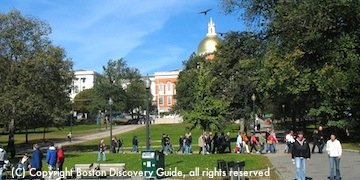
Boston Common marks the start of the Freedom Trail.
Stroll across the Common's green slopes, and you'll be tracing the footsteps of Boston's first Puritan settlers.
You'll walk past areas where Colonial militias trained, where public hangings took place over the span of 3 centuries, and where British troops camped out before heading to Concord on the first day of the American Revolution.
At the edge of the Common next to Beacon Street, spend a few moments at Augustus Saint-Gaudens' magnificent memorial to Robert Gould Shaw and the Massachusetts Fifty-Fourth Regiment, one of the first official African-American units to fight on the side of the United States during the Civil War.
Boston Insider Tip - Where to Get a Free Freedom Trail Map
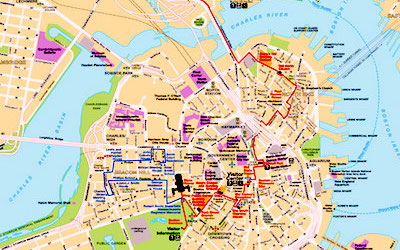
Before you leave the Common, walk over the the Visitor Information Center (147 Tremont Street), and pick up a free National Park Service map of the Freedom Trail and Black Heritage Trail.
To get the free NPS map, you have to go up to the counter at the Visitor Center and ask for the "free Freedom Trail map."
The maps in the display racks are not free.
2. Massachusetts State House
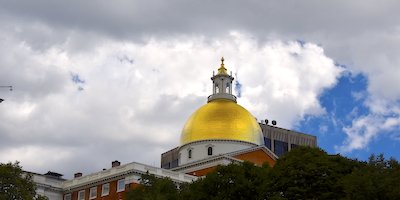
Despite being completed after the end of the Revolutionary War, the Massachusetts State House embodies the self-governance ideals that the Patriots won.
Revolutionary hero and Massachusetts State Governor Samuel Adams laid the State House's cornerstone, famous architect Charles Bulfinch designed it, and its golden dome gleams high above Boston Common and Beacon Hill.
Impressive collections of art and historic memorabilia give you reason enough to visit (free admission), plus you can also see the government and legislative chambers.
More about what to see in the Massachusetts State House
3. Park Street Church
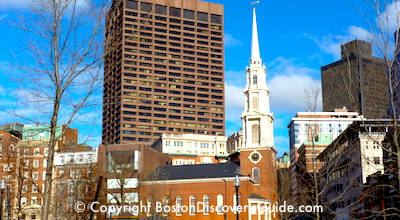
The soaring steeple of Park Street Church is now somewhat dwarfed by taller buildings, but it used to be the first landmark that people saw when coming to Boston.
A number of "firsts" promoting American freedom, human rights, and social justice took place in this historic Downtown Boston landmark, including William Lloyd Garrison's first major speech in Boston against slavery in 1829.
Fun Freedom Trail Tours
4. Old Granary Burying Ground
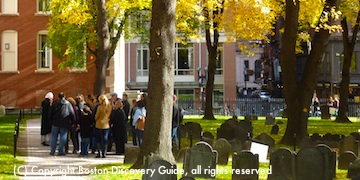
Old Granary Burying Ground, one of Boston's earliest historic sites, dates from 1660.
Due to all the famous patriots and Revolutionary War heroes buried here, it is sometimes called the "Westminster Abbey" of Boston.
Wander through the shaded slopes and you'll discover the graves of Samuel Adams, Paul Revere, and the Boston Massacre victims.
More about Granary Burying Ground
5. King's Chapel
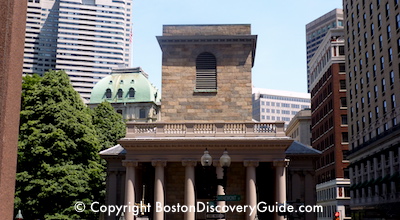
Boston's Puritans fled England to escape religious persecution. Not surprisingly, Church of England religious services were banned in Boston.
So imagine the Puritans' outrage when the English king demanded they build King's Chapel, an Anglican church, on part of a Puritan graveyard (now called King's Chapel Burying Ground).
Like Park Street Church, King's Chapel is still home to an active religious congregation, and is the site of weekly concerts.
6. King's Chapel Burying Ground
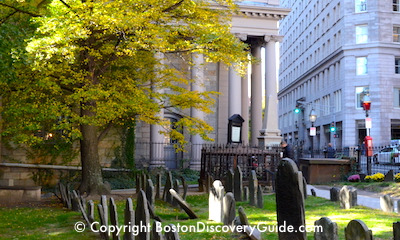
King's Chapel Burying Ground is Boston's oldest graveyard.
You'll find intricately carved gravestones for many of the first English settlers in this tranquil spot.
Look for the one showing Father Time wrestling with Death. And if you enjoy ghost stories, this burying ground has a real chiller.
More about King's Chapel Burying Ground
7. Benjamin Franklin Statue
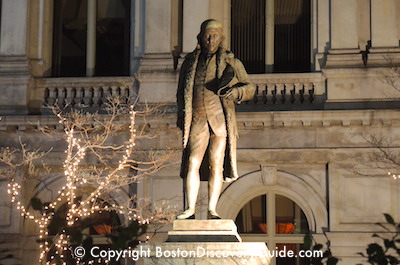
Born poor in Boston in 1706, Benjamin Franklin became a printer, publisher, political thinker, scientist, writer, inventor, and statesman.
He got his start by writing for his brother's newspaper under the name of Mrs. Silence Dogood - until his jabs at witch-hunter Reverend Cotton Mather and other Puritan political powers in Boston landed him in hot water, causing him to flee to Philadelphia.
More about Benjamin Franklin in Boston
8. Old Corner Bookstore
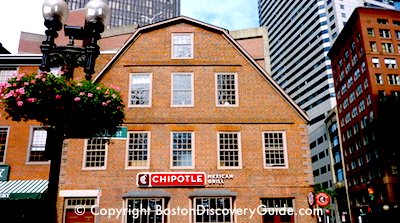
Built in 1718 and one of Boston's oldest brick buildings, the Old Corner Bookstore has always been a commercial space.
Once occupied by the company that published famous 19th century authors Ralph Waldo Emerson, Henry David Thoreau, Nathaniel Hawthorne, and many others, the mellow red brick building now houses a fast food chain.
More about the Old Corner Bookstore
9. Old South Meeting House
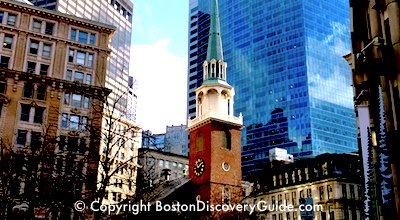
On December 16, 1773, Boston's Old South Meeting House, scene of many speeches supporting liberty, a crowd of 5,000 Colonists waited tensely to hear if ships carrying British tea would be allowed to leave Boston Harbor and go back to England.
When the answer came back as "No!" - meaning they'd have to pay tax on it - they decided to have a tea party in Boston Harbor.
More about Old South Meeting House
10. Old State House
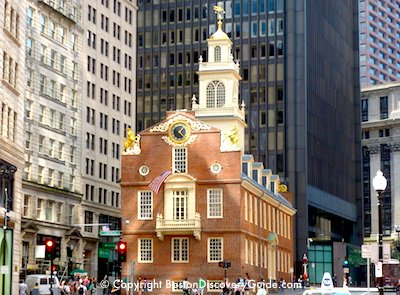
The Massachusetts Assembly and the British Royal Governors met and clashed in the Old State House until the Revolutionary War.
Patriots made some of their most compelling arguments against British tyranny here, and on July 18, 1776, Colonists gathered around an outside balcony to hear the Declaration of Independence read aloud for the first time in Massachusetts.
11. Boston Massacre Site
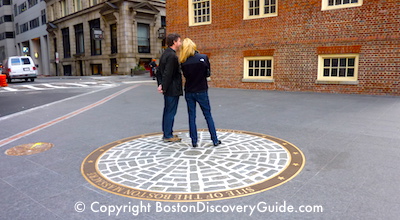
The British occupied Boston in 1768 and tension filled the tavern-lined streets - an explosive combination. On March 5, 1770, a street brawl left 5 colonists dead, killed by Redcoats in what the local Sons of Liberty quickly called the Boston Massacre.
Did the Colonists provoke them? Probably.
More about the Boston Massacre
12. Faneuil Hall
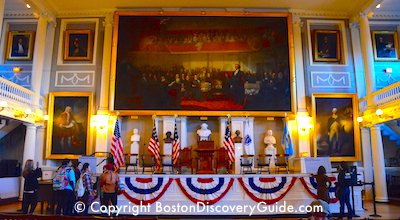
Back in 1742, wealthy merchant Peter Faneuil decided Boston needed a marketplace so he built Faneuil Hall and donated it to Boston.
After Sam Adams and other Sons of Liberty made fiery speeches here, it became known as "The Cradle of Liberty."
Today, Faneuil Hall Marketplace continues to be one of Boston's most popular shopping areas.
More about Faneuil Marketplace and Faneuil Hall
More about shopping in Faneuil Hall Marketplace, also called Quincy Market
13. Paul Revere's House
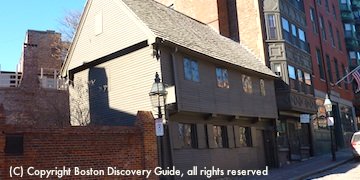
Crafted from carved timbers and wooden pegs, Paul Revere's house, a medieval-style structure in Boston's historic North End neighborhood, is the only 17th century wood dwelling still standing in its original Boston site.
Open today as a museum, the house displays examples of Revere's metal work - spoons, bowls, dental wiring, bells, engraving plates - as well as late 17th century maps, furniture, and furnishings.
More about visiting Paul Revere's house
14. Old North Church
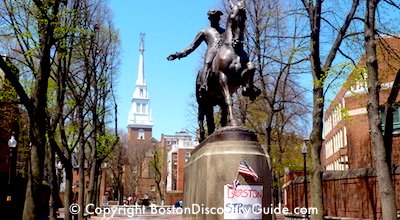
Not far away from Paul Revere's house stands Old North Church. Built in 1723, it is the oldest place of worship still existing in Boston and has an active Episcopal congregation.
In 1775, sexton Robert Newman, a friend of Paul Revere, hung 2 lanterns from the steeple to warn Charleston Patriots about British plans to go by water to Concord.
The best way to access Old North Church: walk along Hanover street to the Prado where a statue of Paul Revere on horseback frames a view of the church's famous steeple.
More about the North End neighborhood
15. Copp's Hill Burial Ground
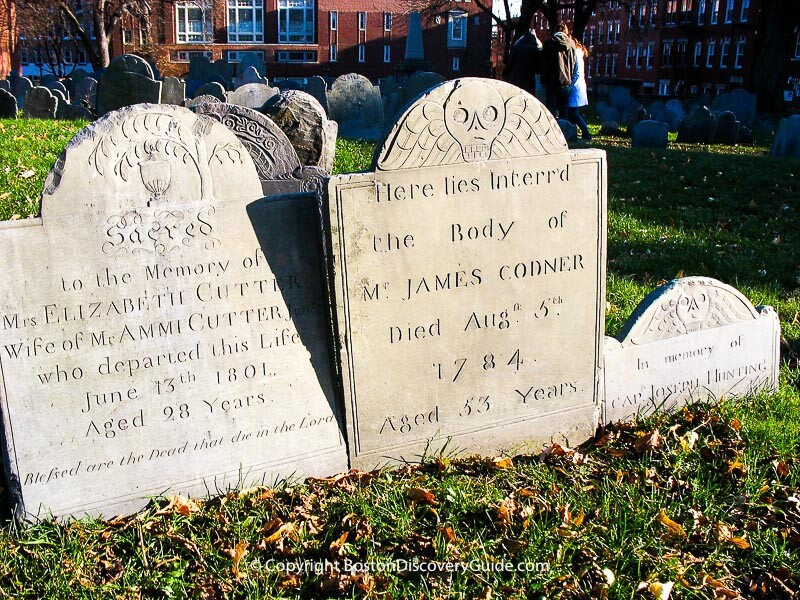
You can still see gravestones with pockmarks from musket balls made when Redcoats used Copp's Hill Burial Ground, for target practice.
This Freedom Trail site dates back to 1659, making it the second-oldest burial ground in Boston.
Take a close look at the oldest tombstones, and you'll find vivid representations of Death.
Because of this hill's excellent sight lines over Boston Harbor, British officers gathered here in 1775 to direct the Battle of Bunker Hill, watch in horror as half their troops died, and then order their remaining forces to burn Charlestown to the ground.
Nearby the burial ground, you can find the site of a later horror: the Great Molasses Flood.
16. USS Constitution
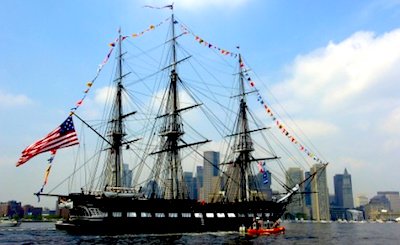
Built in 1793 to protect U.S. merchant ships from attacks by the Barbary pirates, the wooden USS Constitution is the oldest commissioned warship afloat in the world.
Nicknamed "Old Ironsides" after the War of 1812, the Constitution offers free tours by the Navy crew.
If you're walking the Freedom Trail with kids, this is likely to be their favorite spot.
More about the USS Constitution
17. Bunker Hill
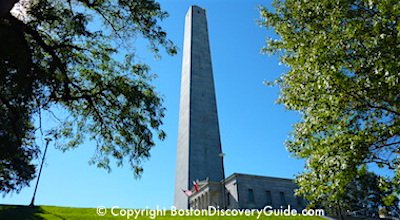
The soaring 221 foot Bunker Hill Monument commemorates the first major battle of the Revolutionary War, and also the deadliest.
Fought on Breed's Hill, half a mile from the real Bunker Hill, the battle lasted only 2 hours. Although the British won the battle, it strengthened the resolve of the Patriots to win the war.
A small history museum (free admission) across from the site on Monument Street displays historic weapons, battle information, and other artifacts - well worth a visit!
Freedom Trail Tours
Freedom Trail Tours give you a fun and informative way to see the city's top historic sites. You can choose from lots of different options: guided walking tours, "drive by" tours on the hop-on hop-off trolleys and duck tours, Boston Harbor cruises past the USS Constitution ("Old Ironsides") and Bunker Hill Monument, and self-guided adventures.
Book your Freedom Trail tour now
Freedom Trail Essentials
Hours: Outdoor Freedom Trail sites such as Boston Common and monuments all day, every day.
Visitor hours for indoor sites vary, so call or check the website for each site that you want to visit.
Churches still in use for worship hold services on Sunday and sometimes at other times which you're welcome to attend; these sites are not open to Trail visitors during these times.
Accessibility: Although many of the sites are wheelchair accessible, some are not due to their age and historical preservation restrictions, so check in advance at each site if applicable.
Cost: Most sites are free. The churches gratefully accept contributions to help with maintenance; King's Chapel charges a small fee (donated to musicians) for concerts and Old North Church charges a small fee to offset the extra maintenance and repairs related to so many tourist visits. Three sites (Old South Meeting House, Old State House, Paul Revere's House) charge modest fees for adults, with reduced rates for children, seniors, and students.
Parking: Choices near the ends and middle of the Freedom Trail include:
- Boston Common Parking Garage, below Boston Common. Enter on Charles Street
- Parking garages near the North End - these also work well for the Faneuil Hall area
- A very limited number of curbside parking spaces as well as commercial parking garages are available in the Charlestown Navy Yard near the USS Constitution site
Boston Freedom Trail Sites
Boston Common | Massachusetts State House | Park Street Church | Granary Burying Ground | King's Chapel | King's Chapel Burying Ground | Benjamin Franklin Statue | Old Corner Bookstore | Old South Meeting House | Old State House | Boston Massacre Memorial | Faneuil Hall | Old North Church | Paul Revere's House | Copp's Hill Burying Ground | Bunker Hill Monument | USS Constitution
Where to Stay near the Freedom Trail
Planning to stay near the Freedom Trail, but not sure where? The Freedom Trail goes through 3 distinct areas: Beacon Hill/Historic Downtown, the North End, and Charlestown. Each areas offers appealing hotels near the Trail:
Beacon Hill/Historic Downtown:
- Omni Parker House - Where Boston Cream Pie began in 1856 and you can savor it today - Rates and Reservations
- Bostonian Boston - Next to Faneuil Marketplace - Compare rates & reviews
- More Historic Downtown hotels
North End
- Battery Wharf - Gorgeous new luxury waterfront hotel - Rates & reviews
- Marriott Long Wharf - Next to the Aquarium on the Downtown Waterfront - Rates & reviews
- More North End hotels
Charlestown:
- Marriott Residence Inn - Families love the suites with kitchenettes - Rates & reservations
- Constitution Inn - One of Boston's lesser-known bargain hotels - Rates/reviews
More Historic Sites near the Freedom Trail
Boston overflows with historic sites. These are especially close to the Freedom Trail, so don't miss them:
- Historic Taverns - Where the Sons of Liberty plotted their Revolution, next to the Freedom Trail
- Boston Tea Party Ships & Museum - Experience what really happened on that fateful night
- Holocaust Memorial - Across from Faneuil Hall Marketplace
- Haymarket - Boston's oldest Marketplace, near Faneuil Hall Marketplace
More Ways to Explore Boston's History
More Articles about Top Boston Attractions
- Top 10 Boston Attractions - Find out about more Top 10 Boston Attractions
- Boston Sightseeing Map - Find neighborhoods where shops are located
- Boston Tours - Find more ways to tour Boston
Need a Boston Hotel or Apartment?
Use this handy map from Booking.com to find the perfect place to stay. Just enter your dates to find what's available, see the best rates, and make your reservations.